
GSA SER can discover targets itself, so a paid link list is optional.[1] Scrape your own when you want control over sourcing and can maintain that work. Buy maintained targets when repeated discovery and preparation are work you want to delegate. Use both when your custom sourcing has a clear purpose alongside a supplied list.
You are choosing how targets reach your projects. You still need to configure those projects, supply content and inspect the links they produce. A list subscription is neither a GSA SER licence nor a managed campaign.
A February 2025 GSA forum discussion asks directly whether to build lists or buy them, including how to judge reliability and usefulness.[4] The question is useful; the replies do not establish a universal winner. Your decision needs a workflow comparison and a test in your intended project.
Compare the preparation work, not the file size
Discovery produces candidate URLs. Identification asks whether a candidate belongs to a supported platform. Cleanup removes repetition and unwanted entries. Your project then has to work with the target and verify its own link. GSA's documented platform selection, filters, registration, content and link-checking capabilities make these distinct parts of the job.[1]
A large file can still contain little that fits your selected engines or intended placements. Conversely, a smaller selection might be worth evaluating if it matches the work you want to do. Neither observation gives you a useful minimum inventory count. Ask what preparation has happened and what remains for your campaign.
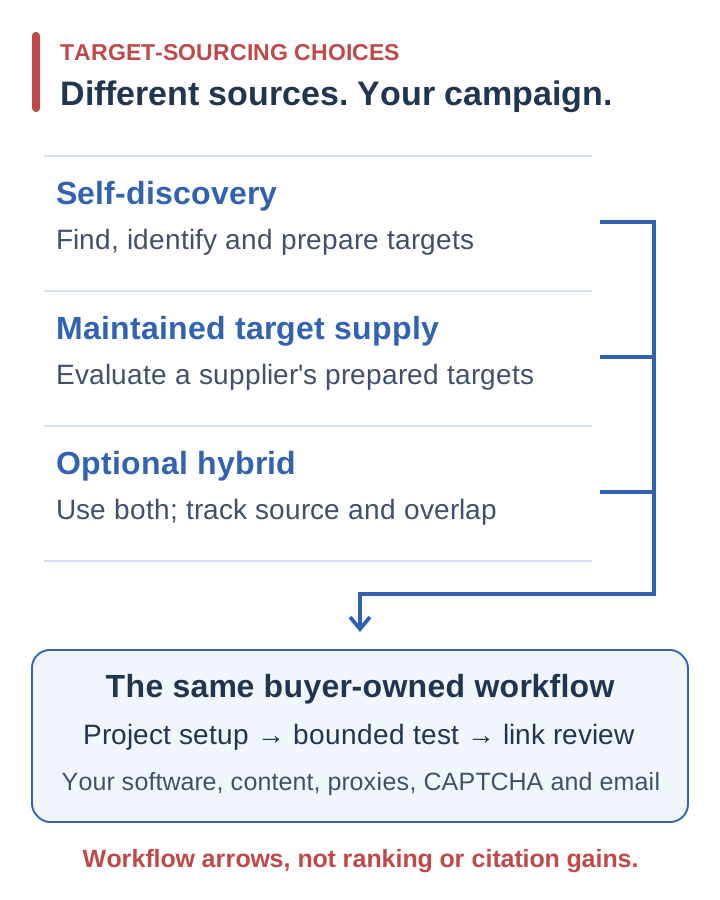
| Approach | Useful when | Work to account for |
|---|---|---|
| Self-discovery | You need custom queries or want direct control over sourcing. | Discovery, identification, cleanup, maintenance and campaign testing |
| Maintained supply | You want prepared targets to evaluate without finding every candidate yourself. | Supplier evaluation, project matching, imports and campaign testing |
| Optional hybrid | You have a specific reason to add custom discoveries to a supplied source. | Both sources, overlap checks and records that distinguish their output |
Hybrid is not automatically better. If two sources mostly repeat each other, the extra workflow may add little. Keep it when it serves a defined need, rather than treating another source as an improvement by itself.
A buyer checklist that goes beyond “verified”
- Ask which platforms fit your projects. Look for relevant engines and placement types, not just a broad category. An article-body link and a forum profile link are different placements even when both appear in a contextual-focused offer.
- Ask what the labels mean. “Top-tier” describes a selection, not a universal quality threshold. “Contextual” does not tell you whether the page is relevant or readable. A dofollow emphasis does not mean every resulting link has identical attributes.
- Distinguish URL deduplication from domain deduplication. Removing a repeated URL does not remove every other page on that domain. Ask which check the supplier performs; do not infer unique domains or exclusive targets from “deduplicated”.
- Understand maintenance. Ask how the supplier handles stale or unwanted targets and how you receive updates. A previous successful verification does not establish that the next project can post there now. Websites and their acceptance conditions can change.
- Check what is actually included. Price the list alongside your software, suitable machine, proxies, CAPTCHA solving, email and content. Those dependencies remain even when the target preparation is supplied.
- Read the purchase terms before testing. Check the commitment, renewal terms, usage restrictions and refund deadline. Plan the evaluation around the actual deadline rather than an assumed free trial.
Verification is useful evidence of a link being found at a particular point. It is not a permanent freshness certificate for every target or a guarantee for your settings. Inspect your resulting pages and link attributes, then recheck persistence separately. Indexing and rankings need their own evidence.
Keep an honest cost and time record
For self-discovery, record the time spent choosing queries, collecting candidates, checking platforms, removing repeats and revisiting failed sources. Include the tools and operating resources you actually pay for. Built-in discovery exists; that does not make your preparation time free.
For maintained supply, record the subscription charge and the time spent evaluating, importing and matching targets to projects. You may still need custom discovery. A fair comparison includes that remaining work instead of crediting the subscription with tasks you continue to do yourself.
Use your own costs and time log. There is no reliable saving to calculate from a seller's file count alone, and no need to invent an hourly saving before you have tested the workflow.
Evaluate in the campaign you intend to run
Choose a bounded sample you can inspect, with a recorded start and stopping point. Hold your software version, engines, filters, content, proxy pool, solver and email setup steady where practical. Keep the sources identifiable and note overlap before comparing their output. This is an evaluation method, not a claim that we have run a controlled comparison.
Record eligibility, submission, verification and recurring failure categories. Watch LPM and VPM, but also inspect the actual pages. A faster run with the wrong placement mix may not meet your requirements. Recheck links later, using comparable observation windows, and record differences in platform mix that limit the comparison.
If both sources stall at the same account, CAPTCHA or email step, investigate that dependency before buying another list. The submitted-but-not-verified diagnostic guide gives you a symptom-and-evidence table for this part of the evaluation.
Selection labels also do not settle strategy. Google's link-spam policy includes automated link creation intended to manipulate rankings.[2] For the wider distinction between automation, search visibility and AI citations, read the AI-search and GSA SER guide.
Where SER Power Lists fits
SER Power Lists gives you a maintained target source for broader GSA SER campaign use: general lists alongside specialised top-tier selections, contextual opportunities, a mostly dofollow mix and automated URL deduplication. Articles, forums, social bookmarking and wikis are priority examples, not the entire platform range. We actively work to reduce indexer, exploit and trackback entries rather than treating every additional URL as useful inventory.
That makes the service a practical option when you want to spend less of your session assembling targets and more of it working on your projects. Keep your own discovery where it serves a purpose. You supply GSA SER, the machine, content, email accounts, proxies and CAPTCHA tools; XEvil and GSA Captcha Breaker are separate options, not bundled licences.
See the list features, then compare plans and choose your subscription. SER Power Lists offers a no-questions refund request within 48 hours of purchase. Set aside time to evaluate before buying: that window starts at purchase, and the purchase is not a free trial.